Tuesday, March 21, 2006

can we get it together?

always running, always returning

send me a message if you're interested.

Tuesday, February 15, 2005

untitled

I remember when Dance Dance Revolution first hit the market. People really thought we were going to enter a new era of dance dancing. We really thought we could revolutionize things.

We were wrong, of course. In the end we were burdened with the same crappy dance dancing as before. As if the Dance Dance Revolution had never happened. As if nothing had changed in the world of dance dance.

I cry about it sometimes.

Thursday, February 10, 2005

louder, louder

That Friday afternoon I fell asleep to the sound of rain, soaking the ground, melting the snow.

I dreamed. Stumbling alone across bloodsoaked trails, through the first snows of winter, through the dying gasps of autumn, of friendship, of love, I dreamed. Haunted? Perhaps, though these three years it's often felt more as though I've returned to that barren, forsaken plain than it to me. To the tired, lonely, the despairing of spring, that bleak sky calls: to rest, to death. Dying, sleeping, I dreamed.

I awake on a bed of marble, on cliffs of ivory, above shining seas of glass.

I am alone.


------
look, contribution!

by the way, if you've only heard of Jorge Luis Borges in context of a high-school "spanish culture" lesson, you really check him out. it's well worth your while, i promise -- especially if the measure of "your while" can be taken from the five minutes you just spent reading this brainshit.

Monday, February 07, 2005

"modern"

The new MoMA has amazing architecture. Each corner has a blue-tinted floor-to-ceiling window that allows one to see everything from a top-down view of people on the street to the tops of the adjoining 53rd/54th St. skyscrapers and beyond into the New York skyline. The rooms project infinite space in each direction around the frames of the paintings hung on them, in a very un-Japanese filling of space (though the white-rules-all aesthetic is resolutely Eastern minimalist). Each floor past the second has a catwalk from which there is an overlook onto the second floor lobby, onto a broken obelisk and a beautiful three-panel Monet scene. Above is a cutaway look at people going down the stairs, a dynamic artwork in and of itself. In the other direction is the immaculate sculpture garden, visible from a number of vantage points around the museum. It's all very sleek and subtly brilliant.

They still have trouble with the word 'modern,' though. For the love of god, give 'Starry Night' to another museum already.

Wednesday, February 02, 2005

A gaping hole

I've noticed that the English language does not seem to have an adjective describing a person who has to go to the bathroom.

Sunday, January 02, 2005

the great black hope

By far, the best politician--no, statesman--this country currently has and has had in a while, Democrat or Republican. May God bless Barack Obama.

Dreams from My Father: A Story of Race and Inheritance
Barack Obama

Three Rivers Press © 2004 by Barack Obama
ISBN: 1-4000-8277-3 Available for purchase at Amazon.com

Excerpt

Preface to the 2004 Edition

Almost a decade has passed since this book was first published. As I mention in the original introduction, the opportunity to write the book came while I was in law school, the result of my election as the first African-American president of the Harvard Law Review . In the wake of some modest publicity, I received an advance from a publisher and went to work with the belief that the story of my family, and my efforts to understand that story, might speak in some way to the fissures of race that have characterized the American experience, as well as the fluid state of identity -- the leaps through time, the collision of cultures -- that mark our modern life.

Like most first-time authors, I was filled with hope and despair upon the book's publication -- hope that the book might succeed beyond my youthful dreams, despair that I had failed to say anything worth saying. The reality fell somewhere in between. The reviews were mildly favorable. People actually showed up at the readings my publisher arranged. The sales were underwhelming. And, after a few months, I went on with the business of my life, certain that my career as an author would be short-lived, but glad to have survived the process with my dignity more or less intact.

I had little time for reflection over the next ten years. I ran a voter registration project in the 1992 election cycle, began a civil rights practice, and started teaching constitutional law at the University of Chicago. My wife and I bought a house, were blessed with two gorgeous, healthy, and mischievous daughters, and struggled to pay the bills. When a seat in the state legislature opened up in 1996, some friends persuaded me to run for the office, and I won. I had been warned, before taking office, that state politics lacks the glamour of its Washington counterpart; one labors largely in obscurity, mostly on topics that mean a great deal to some but that the average man or woman on the street can safely ignore (the regulation of mobile homes, say, or the tax consequences of farm equipment depreciation). Nonetheless, I found the work satisfying, mostly because the scale of state politics allows for concrete results -- an expansion of health insurance for poor children, or a reform of laws that send innocent men to death row -- within a meaningful time frame. And too, because within the capitol building of a big, industrial state, one sees every day the face of a nation in constant conversation: inner-city mothers and corn and bean farmers, immigrant day laborers alongside suburban investment bankers -- all jostling to be heard, all ready to tell their stories.

A few months ago, I won the Democratic nomination for a seat as the U.S. senator from Illinois. It was a difficult race, in a crowded field of well-funded, skilled, and prominent candidates; without organizational backing or personal wealth, a black man with a funny name, I was considered a long shot. And so, when I won a majority of the votes in the Democratic primary, winning in white areas as well as black, in the suburbs as well as Chicago, the reaction that followed echoed the response to my election to the Law Review . Mainstream commentators expressed surprise and genuine hope that my victory signaled a broader change in our racial politics. Within the black community, there was a sense of pride regarding my accomplishment, a pride mingled with frustration that fifty years after Brown v. Board of Education and forty years after the passage of the Voting Rights Act, we should still be celebrating the possibility (and only the possibility, for I have a tough general election coming up) that I might be the sole African American -- and only the third since Reconstruction -- to serve in the Senate. My family, friends, and I were mildly bewildered by the attention, and constantly aware of the gulf between the hard sheen of media reports and the messy, mundane realities of life as it is truly lived.
Just as that spate of publicity prompted my publisher's interest a decade ago, so has this fresh round of news clippings encouraged the book's re-publication. For the first time in many years, I've pulled out a copy and read a few chapters to see how much my voice may have changed over time. I confess to wincing every so often at a poorly chosen word, a mangled sentence, an expression of emotion that seems indulgent or overly practiced. I have the urge to cut the book by fifty pages or so, possessed as I am with a keener appreciation for brevity. I cannot honestly say, however, that the voice in this book is not mine -- that I would tell the story much differently today than I did ten years ago, even if certain passages have proven to be inconvenient politically, the grist for pundit commentary and opposition research.

What has changed, of course, dramatically, decisively, is the context in which the book might now be read. I began writing against a backdrop of Silicon Valley and a booming stock market; the collapse of the Berlin Wall; Mandela -- in slow, sturdy steps -- emerging from prison to lead a country; the signing of peace accords in Oslo. Domestically, our cultural debates -- around guns and abortion and rap lyrics -- seemed so fierce precisely because Bill Clinton's Third Way, a scaled-back welfare state without grand ambition but without sharp edges, seemed to describe a broad, underlying consensus on bread-and-butter issues, a consensus to which even George W. Bush's first campaign, with its "compassionate conservatism," would have to give a nod.
Internationally, writers announced the end of history, the ascendance of free markets and liberal democracy, the replacement of old hatreds and wars between nations with virtual communities and battles for market share.

And then, on September 11, 2001, the world fractured.

It's beyond my skill as a writer to capture that day, and the days that would follow -- the planes, like specters, vanishing into steel and glass; the slow-motion cascade of the towers crumbling into themselves; the ash-covered figures wandering the streets; the anguish and the fear. Nor do I pretend to understand the stark nihilism that drove the terrorists that day and that drives their brethren still. My powers of empathy, my ability to reach into another's heart, cannot penetrate the blank stares of those who would murder innocents with abstract, serene satisfaction.

What I do know is that history returned that day with a vengeance; that, in fact, as Faulkner reminds us, the past is never dead and buried -- it isn't even past. This collective history, this past, directly touches my own. Not merely because the bombs of Al Qaeda have marked, with an eerie precision, some of the landscapes of my life -- the buildings and roads and faces of Nairobi, Bali, Manhattan; not merely because, as a consequence of 9/11, my name is an irresistible target of mocking websites from overzealous Republican operatives. But also because the underlying struggle -- between worlds of plenty and worlds of want; between the modern and the ancient; between those who embrace our teeming, colliding, irksome diversity, while still insisting on a set of values that binds us together, and those who would seek, under whatever flag or slogan or sacred text, a certainty and simplification that justifies cruelty toward those not like us -- is the struggle set forth, on a miniature scale, in this book.

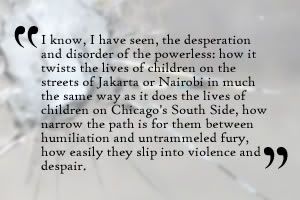
I know, I have seen, the desperation and disorder of the powerless: how it twists the lives of children on the streets of Jakarta or Nairobi in much the same way as it does the lives of children on Chicago's South Side, how narrow the path is for them between humiliation and untrammeled fury, how easily they slip into violence and despair. I know that the response of the powerful to this disorder -- alternating as it does between a dull complacency and, when the disorder spills out of its proscribed confines, a steady, unthinking application of force, of longer prison sentences and more sophisticated military hardware -- is inadequate to the task. I know that the hardening of lines, the embrace of fundamentalism and tribe, dooms us all.

And so what was a more interior, intimate effort on my part, to understand this struggle and to find my place in it, has converged with a broader public debate, a debate in which I am professionally engaged, one that will shape our lives and the lives of our children for many years to come.

The policy implications of all this are a topic for another book. Let me end instead on a more personal note. Most of the characters in this book remain a part of my life, albeit in varying degrees -- a function of work, children, geography, and turns of fate.

The exception is my mother, whom we lost, with a brutal swiftness, to cancer a few months after this book was published.

She had spent the previous ten years doing what she loved. She traveled the world, working in the distant villages of Asia and Africa, helping women buy a sewing machine or a milk cow or an education that might give them a foothold in the world's economy. She gathered friends from high and low, took long walks, stared at the moon, and foraged through the local markets of Delhi or Marrakesh for some trifle, a scarf or stone carving that would make her laugh or please the eye. She wrote reports, read novels, pestered her children, and dreamed of grandchildren.
We saw each other frequently, our bond unbroken. During the writing of this book, she would read the drafts, correcting stories that I had misunderstood, careful not to comment on my characterizations of her but quick to explain or defend the less flattering aspects of my father's character. She managed her illness with grace and good humor, and she helped my sister and me push on with our lives, despite our dread, our denials, our sudden constrictions of the heart.

I think sometimes that had I known she would not survive her illness, I might have written a different book -- less a meditation on the absent parent, more a celebration of the one who was the single constant in my life. In my daughters I see her every day, her joy, her capacity for wonder. I won't try to describe how deeply I mourn her passing still. I know that she was the kindest, most generous spirit I have ever known, and that what is best in me I owe to her.


Excerpt totally illegal; the image with the quote used a photo from Mariya's Xanga.

Wednesday, December 29, 2004

college essay? fuck no!

the following isn't going to any colleges. i just thought i'd write a georgetownesque college essay.

You can see pictures of it on the news right now, the destruction along the coastlines of India, Sri Lanka, Indonesia and Thailand. In Colombo, Sri Lanka, drowned bodies have hidden themselves amidst the rubble, thrown back ashore by the tsunami that had pulled them into the ocean. Bulldozers shovel hundreds of unidentified corpses into massive graves and funeral pyres. Thousands of homeless children search desperately for food, shelter and their parents. This is only a small fraction of the images of this recent, natural brutality. As of this moment, the death toll is already climbing past 57,000, and it shows no signs of faltering.

I have relatives in Malaysia who were spared by the earthquake and ensuing tidal wave that shook the shorelines of Asia. Luckily, they were a safe distance away from the damage, in Korea, where they were spending their vacation. I was relieved to know that they never saw the macabre scene that was afflicting several nations. However, there are still victims in a relatively untouched country like Malaysia, where there are at least 65 people whose lives were taken away by this catastrophe. It makes me feel almost selfish to harbor favoritism for those to whom I am close, instead of showing compassion and lending a helping hand to all those who have been severely affected by this traumatizing event. There are those who would just read about this incident in their newspaper, feel a fleeting breath of pity for those who faced devastation and then forget about it after doing nothing else. There are even those who would brush this off as another episode of a succession of events where thousands of lives are lost. I realize that I am a culprit of such thoughts and inactions. It?s wrong to be so heartless.

The most sympathetic contributors to the earthquake and tsunami survivors are those who hold personal relations with these battered victims. However, worldly insight causes many to be concerned with such affairs where humanitarian aid is needed. I know now that I walk along liminal paths toward both dimensions. Having felt a foreboding sense of familial loss, I became aware of the hardships of human life in many parts of the world. Most of the world isn?t as pampered as I am. It is only right for them to have of chance to experience the kind of comfortable life that I have taken for granted.

I hope that these events are having a reverberating impact on people on this side of the globe, where many are often unaffected by the news of cataclysmic events occurring thousands of miles away. Many are doing what little they can to support the survivors who are doing just that--surviving. Along with those who have felt this wave of charity beat gently against their psyche, I am also providing alms to those who need it. As I kindle this newfound sense of altruism, I wish with optimism that the resounding echoes of this human tragedy never fade from memory, and that they will continue to pulsate as a symbol of beneficence in a time of great crisis.

Godspeed, Médecins Sans Frontières.